
IISER Bhopal finds 75% increase in greenhouse gas emission in India
Bhopal, Sep 27 (IANS) Researchers at the Indian Institute of Science Education and Research (IISER), Bhopal, have developed a novel satellite technology which showed a whopping 75 per cent increase in greenhouse gas emissions from agricultural residue burning across India in the past decade.
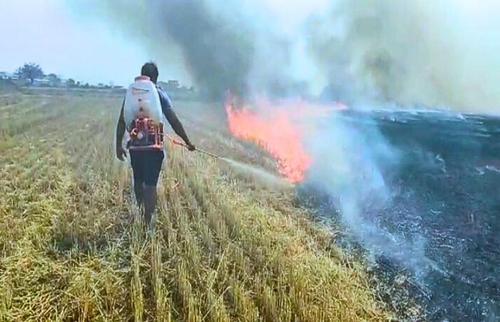
To clear their fields to sow subsequent crops, farmers burn some 87 million tonnes of crop residues annually, surpassing the entire agricultural waste production of peers in the neighbouring countries.
“Crop residue burning has significant repercussions, as it releases pollutants and greenhouse gases to the atmosphere, leading to severe and adverse impacts on climate, public health, and food security,” said Dhanyalekshmi K. Pillai, Assistant Professor at IISER Bhopal.
The team, including from CIMMYT and University of Michigan, leveraged remote sensing technology to offer precise insights into the scale of such emissions across the country.
Punjab emerged as the highest emitter, with 27 per cent of its cultivated area burned in 2020, closely followed by Madhya Pradesh, revealed the data published in the journal Science of the Total Environment.
The burning of rice, wheat, and maize crops accounted for 97 per cent of India’s agricultural burning emissions, with rice being the largest contributor at 55 per cent.
Tackling the challenges of crop residue burning requires knowing the spatial and time-dependent emissions across the country.
The novel satellite technology can facilitate monitoring of residue burning and provide region-specific mitigation strategies and policy interventions to combat this grave environmental crisis, emphasising the role of science and technology in shaping a sustainable future.