


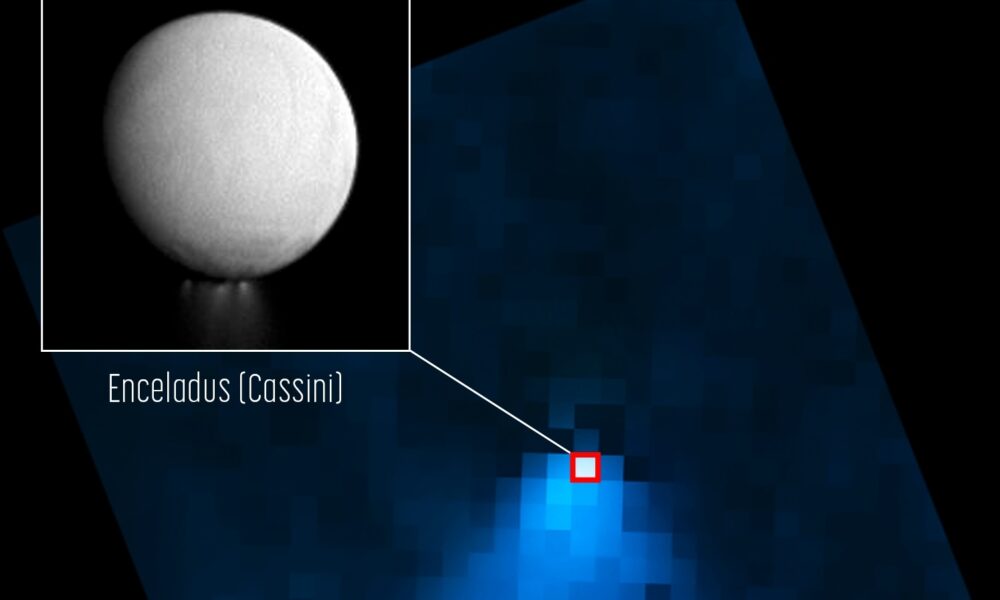
Webb telescope maps large plume jetting from Saturn’s moon
New York, May 31 (IANS) A water vapour plume from Saturn’s moon Enceladus spanning more than 6,000 miles has been detected by researchers using the world’s premier space science observatory James Webb Space Telescope.
Using the data from scientists can also, for the first time, take a direct look at how this emission feeds the water supply for the entire system of Saturn and its rings.
Enceladus, an ocean world about 4 per cent the size of Earth, just 313 miles across, is one of the most exciting scientific targets in our solar system in the search for life beyond Earth.
Sandwiched between the moon’s icy outer crust and its rocky core is a global reservoir of salty water. Geyser-like volcanoes spew jets of ice particles, water vapour, and organic chemicals out of crevices in the moon’s surface informally called ‘tiger stripes’.
“When I was looking at the data, at first, I was thinking I had to be wrong. It was just so shocking to detect a water plume more than 20 times the size of the moon,” lead author Geronimo Villanueva from NASA’s Goddard Space Flight Center in Greenbelt, Maryland, said in a statement.
“The water plume extends far beyond its release region at the southern pole.”
In addition to the length of the plume, the team found that the water vapour is gushing out, about 79 gallons per second, which can fill an Olympic-sized swimming pool in just a couple of hours.
“The orbit of Enceladus around Saturn is relatively quick, just 33 hours. As it whips around Saturn, the moon and its jets are basically spitting off water, leaving a halo, almost like a donut, in its wake. In the Webb observations, not only was the plume huge, but there was just water absolutely everywhere,” said Villanueva.
This fuzzy donut of water that appeared ‘everywhere’, described as a torus, is co-located with Saturn’s outermost and widest ring – the dense ‘E-ring’.
The Webb observations, available as a pre-print on Nature Astronomy, directly demonstrate how the moon’s water vapour plumes feed the torus. By analysing the Webb data, astronomers have determined roughly 30 per cent of the water stays within this torus, and the other 70 per cent escapes to supply the rest of the Saturnian system of water.
In the coming years, Webb will serve as the primary observation tool for ocean moon Enceladus, and discoveries from Webb will help inform future solar system satellite missions that will look to explore the subsurface ocean’s depth, how thick the ice crust is, and more.
Webb is an international programme led by NASA with its partners, European Space Agency (ESA), and Canadian Space Agency (CSA).