


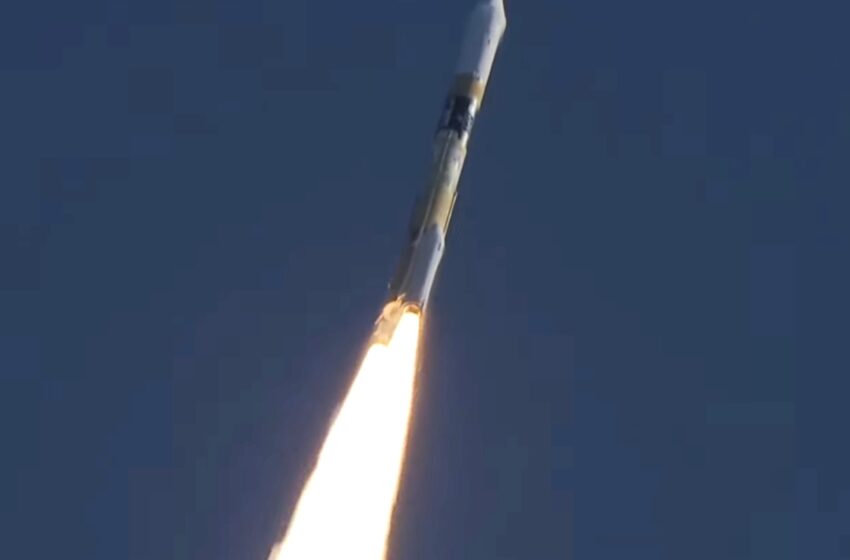
Japan finally launches lunar lander, X-ray mission to Moon
Tokyo, Sep 7 (IANS) Japan has finally launched its Moon lander and X-ray mission, after being delayed thrice last month over bad weather.
If successful, Japan will become just the fifth country to successfully soft-land on the Moon, after Russia, US, China and India.
According to Japan Aerospace Exploration Agency (JAXA), SLIM (Smart Lander for Investigating Moon) and X-Ray Imaging and Spectroscopy Mission (XRISM) lifted off aboard a homegrown H-IIA rocket from Tanegashima Space Center in southern Japan.
“The big objective of SLIM is to prove the high-accuracy landing … to achieve ‘landing where we want’ on the lunar surface, rather than ‘landing where we can’,” JAXA President Hiroshi Yamakawa told a news conference.
JAXA’s SLIM aims to achieve a lightweight probe system on a small scale and use the pinpoint landing technology necessary for future lunar probes, while XRISM will help scientists observe plasma in stars and galaxies.
SLIM, also known as “Moon Sniper” in Japanese, is expected to arrive in lunar orbit 3 to 4 months after launch. If successful, the spacecraft will land on the slope of Shioli Crater, a relatively fresh, 300-metre-wide impact feature within Mare Nectaris, at 13 degrees south latitude and 25 degrees east longitude on the near side of the moon.
XRISM, a collaboration between NASA and JAXA and with cooperation from the European Space Agency (ESA), will observe X-rays released by extreme phenomena such as hot gas clouds enveloping galaxies and blasts from black holes.
“X-ray astronomy enables us to study the most energetic phenomena in the Universe. It holds the key to answering important questions in modern astrophysics: how the largest structures in the Universe evolve, how the matter we are ultimately composed of was distributed through the cosmos, and how galaxies are shaped by massive black holes at their centres,” said Matteo Guainazzi, ESA project scientist for XRISM, in a statement.
The launch comes after India, two weeks ago, became the first nation to land on the South Pole of the Moon with its Chandrayaan-3 mission. Around the same time, Russia’s Luna-25 lander crashed while approaching the moon.
Japan has previously failed in two lunar landing attempts. JAXA lost contact with the OMOTENASHI lander and scrubbed an attempted landing in November, while the Hakuto-R Mission 1 lander, by Japanese startup ispace, crashed in April as it attempted to descend to the lunar surface.