


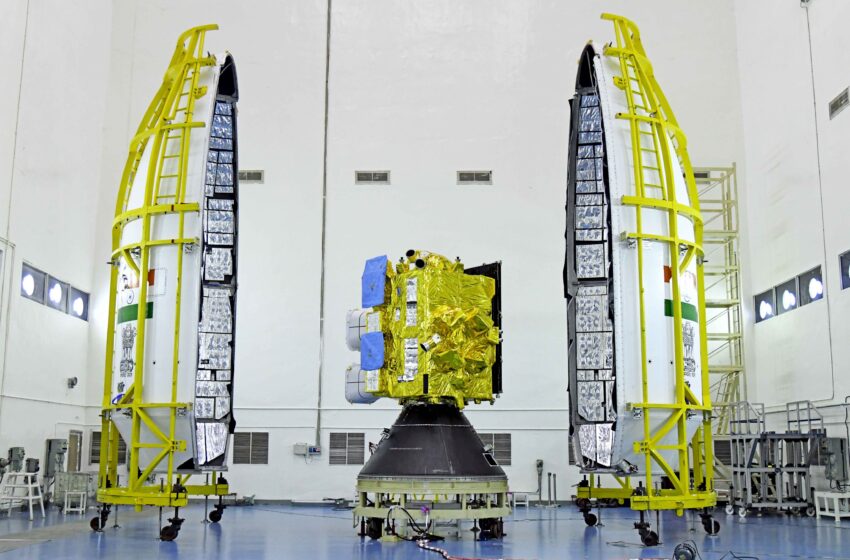
India to put new meteorological satellite INSAT-3DS into orbit on Feb 17
Chennai, Feb 8 (IANS) India will put into orbit its new meteorological satellite INSAT-3DS on February 17 at 5.30 p.m. with the Geosynchronous Satellite Launch Vehicle (GSLV) rocket, the Indian space agency said on Thursday.
According to Indian Space Research Organisation (ISRO), in its 16th mission, the GSLV aims to put INSAT-3DS into the Geosynchronous Transfer Orbit.
Subsequent orbit-raising manoeuvres will ensure that the satellite is positioned in a Geo-Stationary Orbit.
The INSAT-3DS is India’s third generation meteorological satellite and is fully funded by the Ministry of Earth Sciences. It is designed for enhanced meteorological observations and monitoring of land and ocean surfaces for weather forecasting and disaster warning.
The satellite will augment the meteorological services along with the presently operational INSAT-3D and INSAT-3DR satellites.
Various departments under the Ministry of Earth Sciences such as the India Meteorology Department (IMD), National Centre for Medium-Range Weather Forecasting (NCMRWF), Indian Institute of Tropical Meteorology (IITM), National Institute of Ocean Technology (NIOT), Indian National Center for Ocean Information Services (INCOIS) and various other agencies and institutes will be using the INSAT-3DS satellite data to provide improved weather forecasts and teorological services.
The Indian space agency said the primary objectives of the mission are: To monitor Earth’s surface, carry out oceanic observations and its environment in various spectral channels of meteorological importance; to provide the vertical profile of various meteorological parameters of the atmosphere; to provide data collection and data dissemination capabilities from the data collection platforms (DCPs); and to provide satellite aided search and rescue services.