
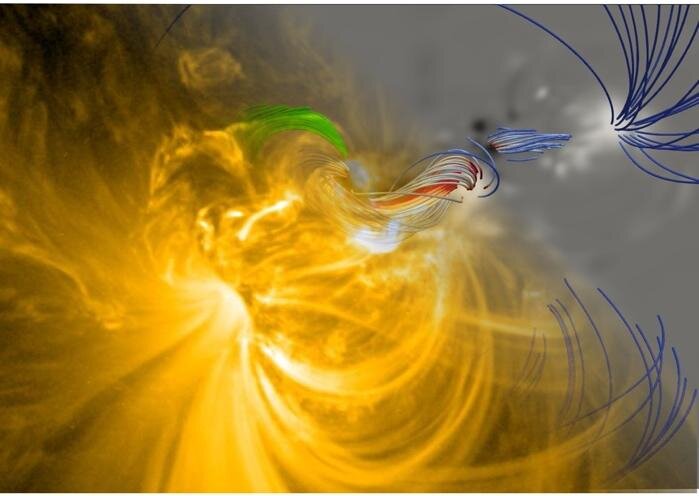
AI shares new insights into solar magnetic field
London, July 17 (IANS) Scientists have achieved a breakthrough in solar physics by utilising artificial intelligence (AI) to simulate the magnetic field in the upper atmosphere of the sun in quasi real-time.
The research, published in Nature Astronomy, holds immense promise for advancing our understanding of the sun’s behaviour and its impact on space weather.
The solar magnetic field is the main driver of space weather, which can cause damage to critical infrastructures like electricity, aviation, and our space-based technology. The main source of severe space weather events are solar active regions, which are regions around sunspots where strong magnetic fields emerge through the solar surface.
Current observing capabilities only allow measuring the magnetic field at the surface of the sun, however, the energy buildup and release happens higher up in the solar atmosphere, the sun’s corona.
By leveraging the capabilities of physics-informed neural networks, the team from the University of Graz in Austria and Skolkovo Institute of Science and Technology in Russia, successfully managed to integrate observational data with the physical force-free magnetic field model.
They provided a comprehensive understanding of the connection between the observed phenomena and the underlying physics that governs the sun’s activity.
This cutting-edge method marks a significant milestone in solar physics and opens up new opportunities for numerical simulations of the sun.
The researchers simulated the evolution of an observed solar active region and demonstrated the ability to perform force-free magnetic field simulations in real-time.
Impressively, this process only required less than 12 hours of computation time to simulate an observation series of five days.
This unprecedented speed enables scientists to conduct real-time analysis and forecasts of solar activity, enhancing our ability to predict space weather events.
“Our use of artificial intelligence in this context represents a transformative leap forward. The use of AI techniques for numerical simulations allows us to better incorporate observational data and holds great potential to further advance our simulation capabilities,” said lead researcher Robert Jarolim from the University of Graz.
“The computing speed holds significant promise for improving space weather forecasting and advancing our knowledge of the sun’s behaviour,” added Tatiana Podlachikova, Associate Professor at Skoltech.
The team further studied the time evolution of free magnetic energy within the coronal volume, which is linked to solar eruptive events on the sun like coronal mass ejections — large plasma clouds ejected from the atmosphere of the sun at speeds of 100-3,500 km/s.
The comparison to extreme ultraviolet observations confirmed the robustness and accuracy of the methodology. Crucially, the results revealed significant depletions of free magnetic energy, both spatially and temporally, which directly correlate with observed solar eruptions.