


Webb celebrates 1st year of science with stunning images of Sun-like stars
Washington, July 13 (IANS) The powerful next generation James Webb Space Telescope has completed a year of science operations, showcasing images ranging from cosmic backyard in the Solar System to distant galaxies near the dawn of time.
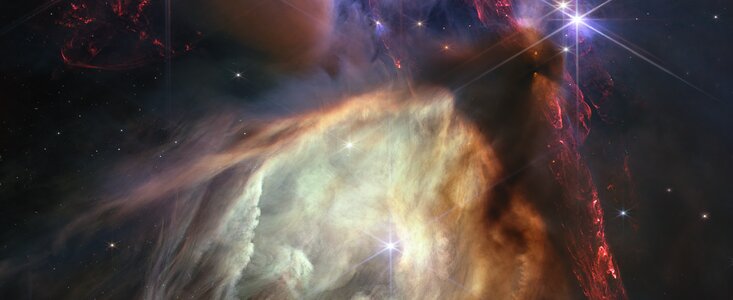
To celebrate the completion of a successful first year, Webb released a new image which shows a small star-forming region in the Rho Ophiuchi cloud complex.
The new image features the nearest star-forming region to Earth. Its proximity at 390 light-years allows for a highly detailed close-up, with no foreground stars in the intervening space.
The showcased region contains approximately 50 young stars, all of them similar in mass to the Sun or smaller. The darkest areas are the densest, where thick dust cocoons still-forming protostars. Huge red bipolar jets of molecular hydrogen dominate the image, appearing horizontally across the upper third and vertically on the right.
These occur when a star first bursts through its natal envelope of cosmic dust, shooting out a pair of opposing jets into space. In contrast, the star S1 has carved out a glowing cave of dust in the lower half of the image. It is the only star in the image that is significantly more massive than the Sun.
Some stars in the image display tell-tale shadows indicating protoplanetary discs — potential future planetary systems in the making.
From its very first deep field image unveiled in July 2022, Webb has revealed much more than distant galaxies in the early Universe.
Beyond the stunning infrared images, what really has scientists excited are Webb’s crisp spectra — the detailed information that can be gleaned from light by the telescope’s spectroscopic instruments.
Webb’s spectra have confirmed the distances of some of the farthest galaxies ever observed, and have discovered the earliest, most distant supermassive black holes.
They have identified the compositions of planet atmospheres (or lack thereof) with more detail than ever before, and have narrowed down what kinds of atmospheres may exist on rocky exoplanets for the first time.
They also have revealed the chemical makeup of stellar nurseries and protoplanetary disks, detecting water, organic carbon-containing molecules, and more.
These observations have resulted in hundreds of scientific papers answering longstanding questions and raising new ones to address with Webb.
The second year of observations has already been selected, with plans to build on an exciting first year that exceeded expectations.
The world’s premier space science observatory, Webb Telescope is an international programme led by NASA with its partners, ESA (European Space Agency) and the Canadian Space Agency.