


Pace of UNSC reform ‘very frustrating’: Council president
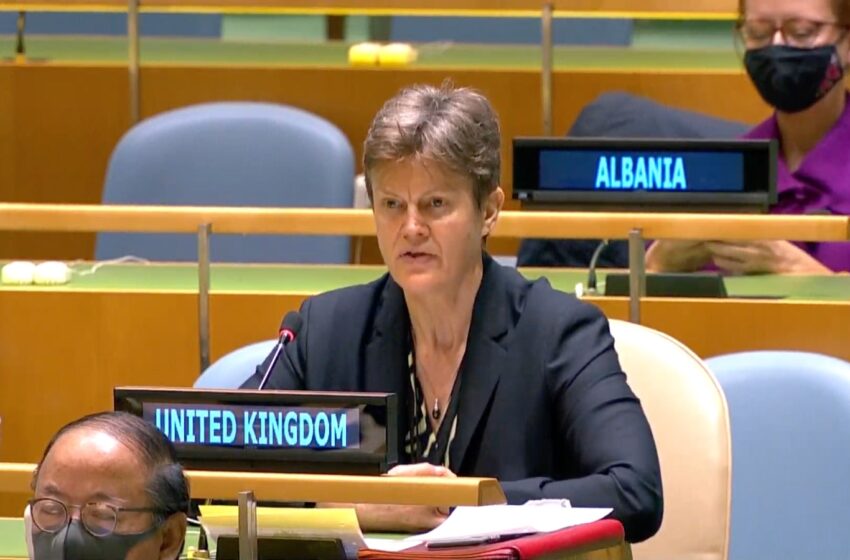
United Nations, July 4 (IANS) UN Security Council President Barbara Woodward has said that the pace of the Council reform process has been “very frustrating” and that her country backs moving on to text-based negotiations.
Woodward, who is Britain’s permanent representative and assumed the rotating presidency for this month, said on Monday, “I recognise that it has been a very frustrating process.”
“We too thought it would be useful actually to move to text-based negotiations, but I’m afraid we didn’t,” she said.
“There wasn’t enough support for that to make immediate progress.”
The reform process which is known as Intergovernmental Negotiations (IGN) ended its meetings for the current session with little progress and for the 25th time rolled over the negotiations to the next session.
One of the roadblocks to advancing the reforms is the failure to adopt a text on which to base the negotiations because of the opposition of a few countries as a way of preventing it from going ahead.
Woodward said that she had been in contact with IGN co-facilitators who led the reform process, Permanent Representatives Tareq AlBanai of Kuwait and Alexander Marschik of Austria, and “I know that they’ve tried very hard indeed but there is such a wide range of views that it seems very difficult indeed, to make progress”.
“So I recognise the frustrations,” she added.
Woodward reiterated Britain’s support for making India, Brazil, Germany and Japan permanent members of the Council to reflect contemporary realities.
Asked about Britain’s choice of the four countries, she said that it had to do with geographic balance and recognising their rising influence.
“Introducing India or Brazil would bring a wider geographical representation into the council, but (would serve) also to bring in countries that have more influence than they had when the original Security Council was put together in 1945, for obvious reasons.”
“So there’s a sort of combination of recognising the world as it is today, alongside geographical balance,” she added.
While India was a founding member of the UN in 1945, it was still a British colony and was not considered a candidate for a permanent seat.
Britain also supports two permanent memberships for African nations who would themselves determine the countries for the seats and one of them could be an Arab- African country, Woodward said.
She referred to a foreign policy speech by Britain’s Foreign Secretary James Cleverly announcing his country’s “ambition to drive forward reform of the multilateral system”.
“And our presidency in July marks the first step in that process,” she added.
She said two items from the priorities he set out that Britain will take up at the UN are Council reforms because “it’s high time the council entered the 2020s,” and technology.
“On technology during our presidency, we’ll be bringing artificial intelligence (AI) to the Security Council for the very first time with our signature event this month,” she added.
“Humanity stands on the precipice of this gigantic, gigantic, technological leap forward” and “we want to encourage a multilateral approach to managing both the huge opportunities and the risks that artificial intelligence holds for all of us,” she said.
The Council meeting on AI on July 18 under the agenda of maintenance of international peace and security will be a precursor to a summit that Britain’s Prime Minister Rishi Sunak is convening to seek agreements on safety measures to evaluate and monitor AI’s most significant risks, according to the British government.
It noted that leading experts have “warned about the potential for AI to endanger humanity in similar ways to pandemics or nuclear weapons”.
(Arul Louis can be contacted at arul.l@ians.in and followed at @arulouis)