


‘Retreating Ladakh glacier may influence summer & winter pattern’
New Delhi, Aug 7 (IANS) Establishing with observations that the Pensilungpa Glacier located in Zanskar, Ladakh, is retreating due to an increase in the temperature and decrease in precipitation during winters, a study shows how it is possible that the precipitation of summer periods at higher altitudes will change from snow to rain, and that may influence the summer and winter pattern.
“Increasing temperature and low winter precipitation are causing retreat of glaciers in Zanskar Valley, Ladakh. Due to continuous rise in the air temperature in line with the global trend, the melting would increase. It is possible that the precipitation of summer periods at higher altitudes will change from snow to rain, and that may influence the summer and winter pattern,” the study released recently said.
Since 2015, a team of scientists from the Wadia Institute of Himalayan Geology (WIHG), Dehradun, has ventured to study the less explored region of the Himalayas, focusing on Zanskar, Ladakh.
The WIHG, an autonomous institution under the Department of Science & Technology, has been working on various aspects of glaciology, i.e. glacier health (mass balance) monitoring, dynamics, discharge, past climatic conditions, speculation for future climate change and its impact on glaciers in the Himalayas.
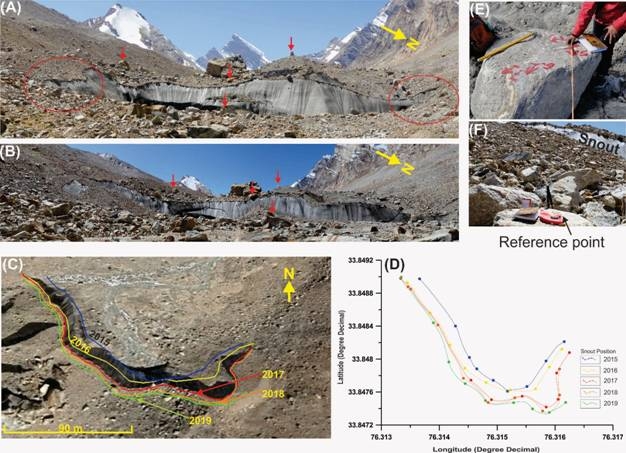
Based on field observations for glaciers’ mass balance collected via stake networking over the glacier surface since 2016-2019, the researchers assessed the impact of climate change through the lens of past and present response of the Pensilungpa Glacier. Stakes made of bamboo are installed (inserted vertically) on the glacier surface using a steam drill for mass balance measurement.
“Field observations for the years 2015 till 2019 showed that the glacier is now retreating at an average rate of 6.7 3 m a-1 and the recessional trends of the Pensilungpa Glacier can be attributed to an increase in the temperature and decrease in precipitation during winters,” the study published in the journal ‘Regional Environmental Change’ said.
It also pointed at the significant influence of debris cover on the mass balance and retreat of the glacier’s endpoint, especially in summer. Furthermore, the mass balance data for the last three years (2016-2019) showed a negative trend with a small accumulation area ratio.
The study, therefore, also suggested that due to continuous rise in the air temperature in line with the global trend, the melting would increase, and “it is possible that the precipitation of summer periods at higher altitudes will change from snow to rain, and that may influence the summer and winter pattern”, the release said.