


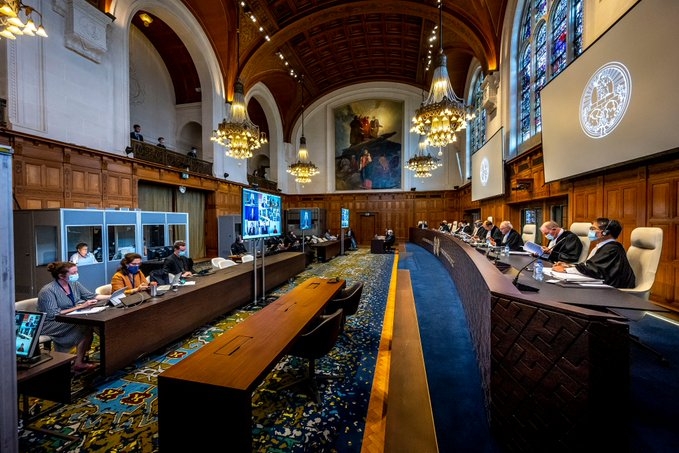
Without real enforcement power, ICJ verdicts are at best moral indictments
New Delhi, Jan 14 (IANS) The ICJ is composed of 15 judges appointed for nine-year terms through separate, simultaneous elections at the UN General Assembly (UNGA) and the UN Security Council (UNSC).
Any country can propose candidates but no two judges must come from one nation, Al Jazeera reported.
At the moment, the bench includes judges from all parts of the world including France, Slovakia, Somalia and India’s Dalveer Bhandari — a former Supreme Court judge and Chief Justice of the Bombay High Court.
To appoint a president and vice president, the judges hold a secret ballot.
President Joan E. Donoghue of the US leads the ICJ presently, alongside Vice President Kirill Gevorgian of Russia.
Both of their terms will expire in February, Al Jazeera reported.
ICJ judges ought to be impartial and not act as extensions of their countries. In the past though, judges have voted in line with their countries’ politics. In 2022, when the bench voted in favour of the decision to order Russia out of Ukraine, judges from Russia and China were the only two who voted against the decision.
Israel and South Africa can appoint one “ad hoc” judge each to join the bench since neither is represented. Aharon Barak, a former Supreme Court chief justice and Holocaust survivor, is Israel’s choice.
Barak was accused of “legitimising” Israeli occupation of Palestine during his stint at the top court.
South Africa has appointed Dikgang Moseneke, a former deputy chief justice, Al Jazeera reported.
While the provisional hearing will be over in a matter of weeks, the main case, which will determine whether Israel is indeed guilty of committing genocide as South Africa claims, will take time.
The Hague-based court will give both parties time to build and submit more detailed arguments.
Multiple hearings will follow. After that, the judges will take a vote, and then a final decision will be announced.
ICJ judgements are legally binding and cannot be appealed. One issue though: The court has no real enforcement power.
If Israel does not comply, South Africa can approach the UNSC for enforcement.
But there, the US, Israel’s number one backer, has veto power as a permanent member. Washington could shield Israel from punishment, as it has done multiple times in this war.
“This is one of the reasons why it’s important to think less about the judgement issued by the ICJ and more about the process itself,” said Mai El-Sadany, the director of Washington-based Tahrir Institute for Middle East Policy.
A full judgement from the court, determining whether Israel has committed genocide in Gaza, will likely take years to emerge, Al Jazeera reported.
A 2019 case that The Gambia brought against Myanmar for its military crackdown on Rohingya refugees is still in trial, for example, more than four years after it began.